Architecture
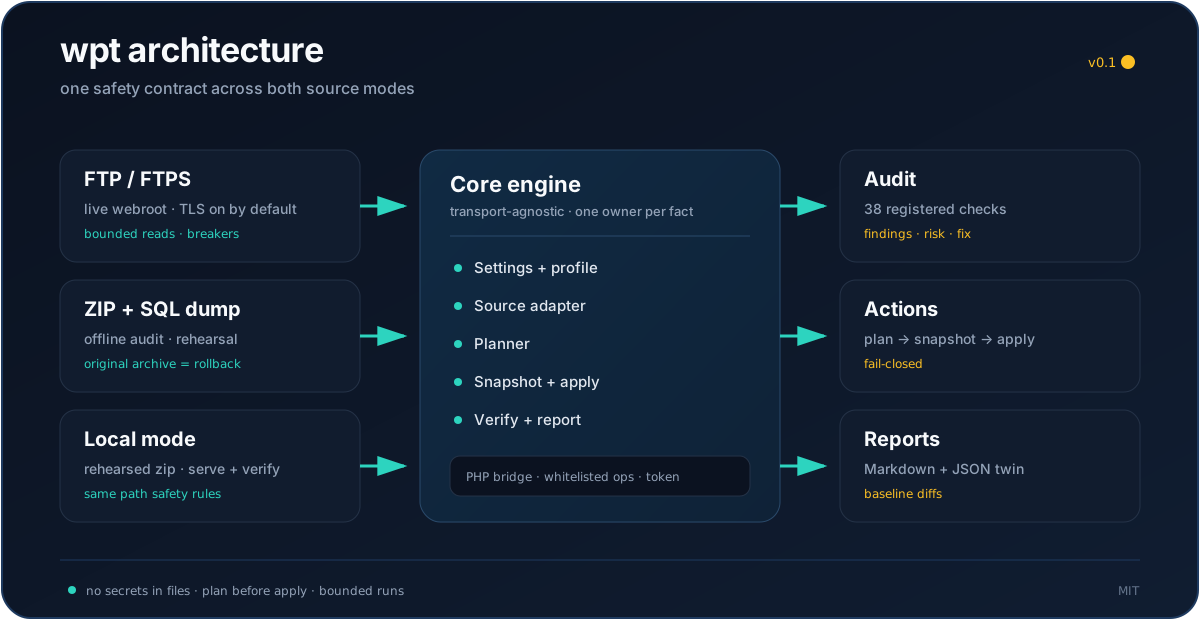
wpt separates the source of a site from the operations performed on it. The
same audit, clean, backup, and verify logic runs against a live FTP webroot or
an offline zip + SQL dump.
Layers
- CLI and settings.
wpt.cliparses commands and global options.wpt.settingsloads the shipped profile and overlays--profile/--set. Every tunable has one owner inwpt/data/profiles/default.json. - Source adapters. FTP/FTPS and zip adapters implement the same source contract. They own path validation, safe reads/writes, atomic replacement, and protected-file rules.
- Core engine. Discovery, planning, deadlines, logging, redaction, snapshots, reports, and the action/audit registries are independent of transport and persistence.
- Actions and audit modules. Capabilities register themselves; new behavior
does not require editing a central switch. Audit checks report findings;
actions produce plans and, on
--apply, execute them. - Bridge. For operations that need WordPress runtime knowledge, a temporary
PHP file is uploaded and called through a whitelisted JSON protocol. It uses
a short-lived token,
hash_equals, an expiry, and a self-destruct request. The bridge exposes named operations only — no arbitrary SQL or PHP. - Reports. Markdown for people and JSON for automation, generated from the same findings and plan items.
Sources
FTP / FTPS
The FTP source is for live sites. FTPS certificate and hostname verification are on by default; a pre-migration opt-out is explicit and logs a warning. Reads are bounded and parallelized with breaker protection. Writes use staged siblings and renames where the server allows it.
Zip + SQL dump
The local source treats a webroot zip as immutable input. A SQL dump is parsed as a stream; it is never loaded whole into memory. Local actions stage changes in an overlay and materialize a new archive, leaving the original as the rollback.
Local rehearsal
A rehearsed archive can be served and verified offline. The same protected-path
rules apply, so a local rehearsal cannot quietly edit wp-config.php or
WordPress core.
Safety boundaries
- Path traversal, control characters, and symlink escapes are refused at the source boundary.
wp-config.php, root.htaccess,index.php,wp-admin, andwp-includesare protected from ordinary writes and deletes.- A write that needs an elevated permission uses an explicit, audited unlock.
- Snapshots are fail-closed: no snapshot, no apply.
- Credentials are read from the environment and redacted at the single logging choke point.
Audit and actions
The audit registry exposes 38 checks across core integrity, security, database health, media, performance, and configuration. Findings carry a category, a risk, an estimated reclaimable size, and a suggested fix.
Actions are registry entries with an applies scope (local, FTP, or both).
Each action builds a plan; the executor applies it only after the gate. The
README command table and the action registry are checked against each other by
tests/test_docs.py.
Tests
The suite is deliberately broad and deterministic:
- behavioral tests for command bodies and invariants;
- contract tests for the README, SPEC, profile, and packaging;
- integration tests for zip, SQL, FTP fakes, PHP bridge, and local serve;
- lifecycle tests for deadlines, cancellation, and shutdown;
- a public-safety scan that checks the working tree for credentials, public-looking IPs, non-example email/domain fixtures, local home paths, and generated or operational artifacts (a release backstop, not a full secret scanner).
Live FTP, SSH, and MySQL boundaries are represented by fakes in CI; live validation is an operator step, not a test dependency.