01 · Run it
Start on a disposable copy
Node 24, a provider you can revoke, and a repository you can lose. The quickstart is explicit about the config mode, the ports, and the first account.
Developer preview Pre-admission AGPL-3.0
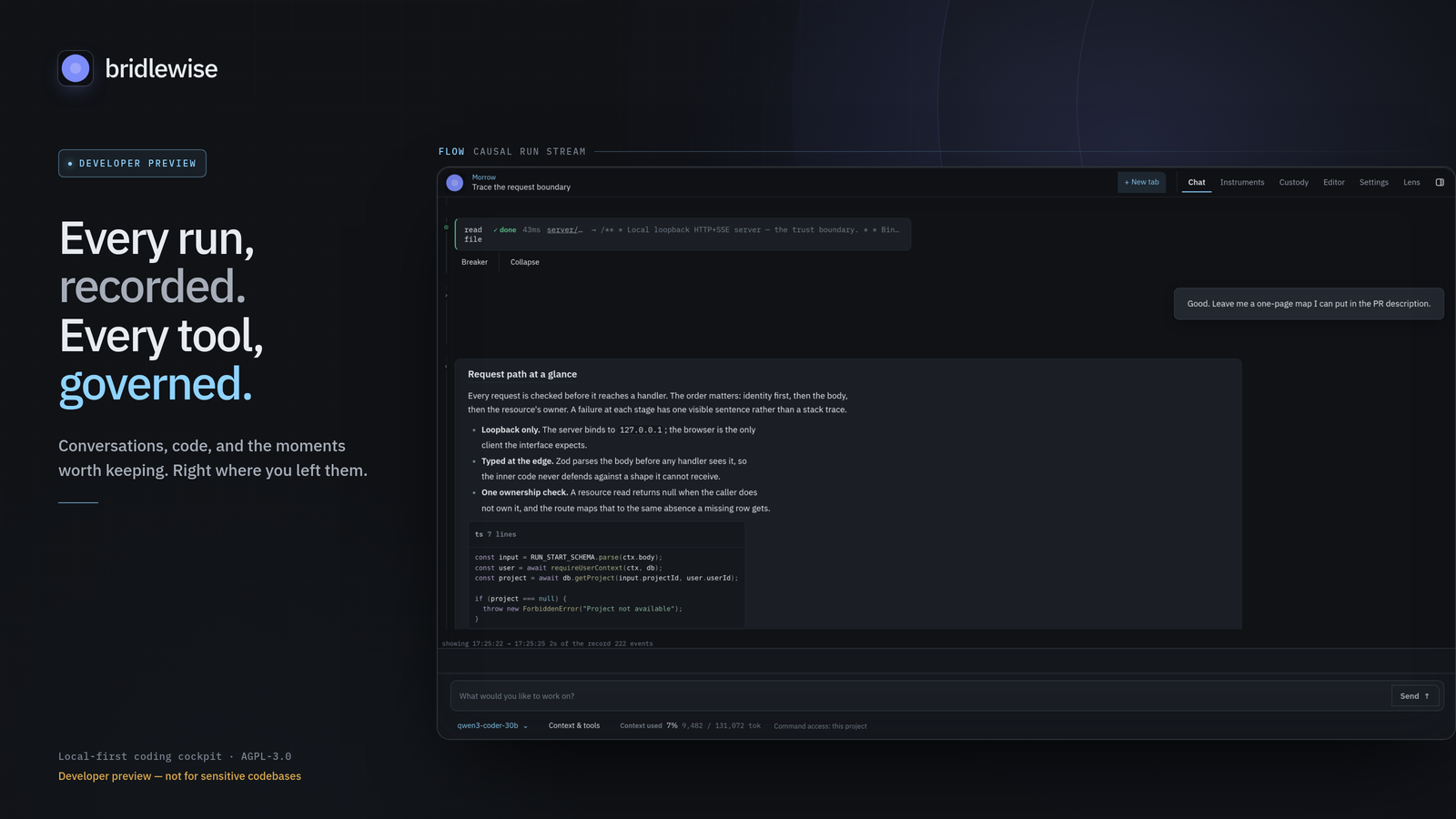
Bridlewise is a coding cockpit you run on your own machine. A conversation becomes a run: a recorded causal stream of model turns, tool calls, file effects, checks, and findings — with the tool surface gated before and during execution. The repository is its flight recorder.
Node 24 · Linux first · loopback only · SQLite · no hosted service
The flight recorder
Most coding agents leave the interesting part in a provider's logs: which tool was called, what it changed, which check moved, and what the system decided not to allow. Bridlewise makes that part the primary surface. A run executes once, persists its stream, and can be reopened without starting a second execution.
The same sequence describes the project's own public record. Intent becomes a README; boundary becomes a security policy; tool becomes a workflow; effect becomes a release; check becomes CI; finding becomes an issue; decision becomes a discussion or a decision record; release becomes the artifact you can inspect.
| Beat | What the record holds |
|---|---|
| 1 · Intent | The prompt, project, model, and plan — what the run is trying to do. |
| 2 · Boundary | The provider, tool registry, policy, project root, and confinement decision. |
| 3 · Tool | The registered tool, typed arguments, and the pre-dispatch gate's answer. |
| 4 · Effect | A file diff, command result, or process effect — with a rollback handle where one exists. |
| 5 · Check | The check, its before-and-after state, and the delta that actually moved. |
| 6 · Finding | What a check or detector found, with its source and derivation. |
| 7 · Decision | Allow, deny, stop, retry, or escalate — including the typed refusals. |
| 8 · Release | What leaves the harness: a diff, a report, a commit, or a published artifact. |
See how each beat maps to a GitHub surface → · Keep the vocabulary sharp →
Three doors
Pick the door that matches what you need to know. None of them requires trusting the marketing copy.
01 · Run it
Node 24, a provider you can revoke, and a repository you can lose. The quickstart is explicit about the config mode, the ports, and the first account.
02 · Read the record
The interactive run is a synthetic record you can explore. The GitHub map shows how the project records its own checks, findings, and releases.
03 · Audit the limits
The threat model, the gap register, and a reading map that goes from 90 seconds to a security review. The warning is part of the product.
Two instruments, clearly labeled
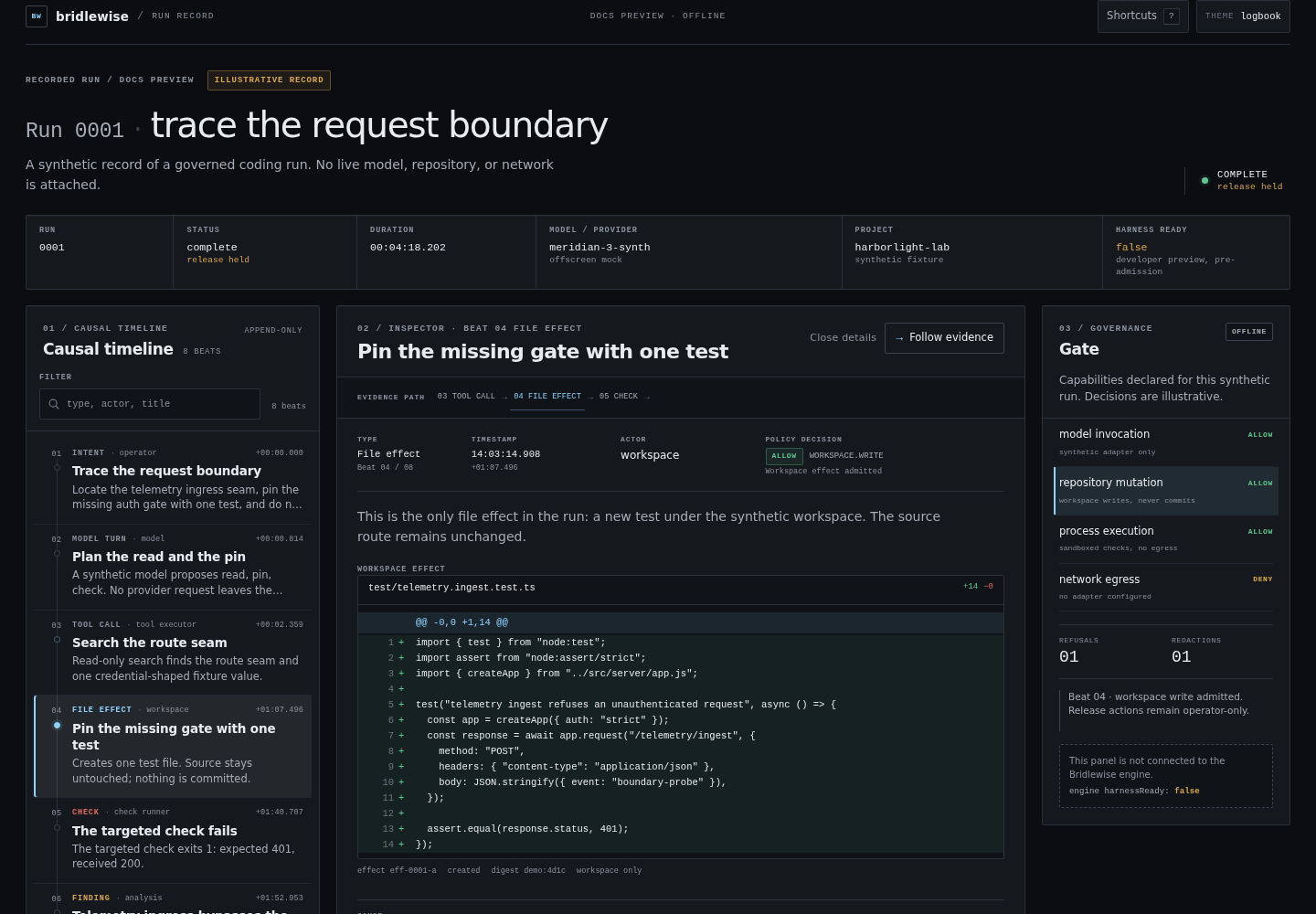
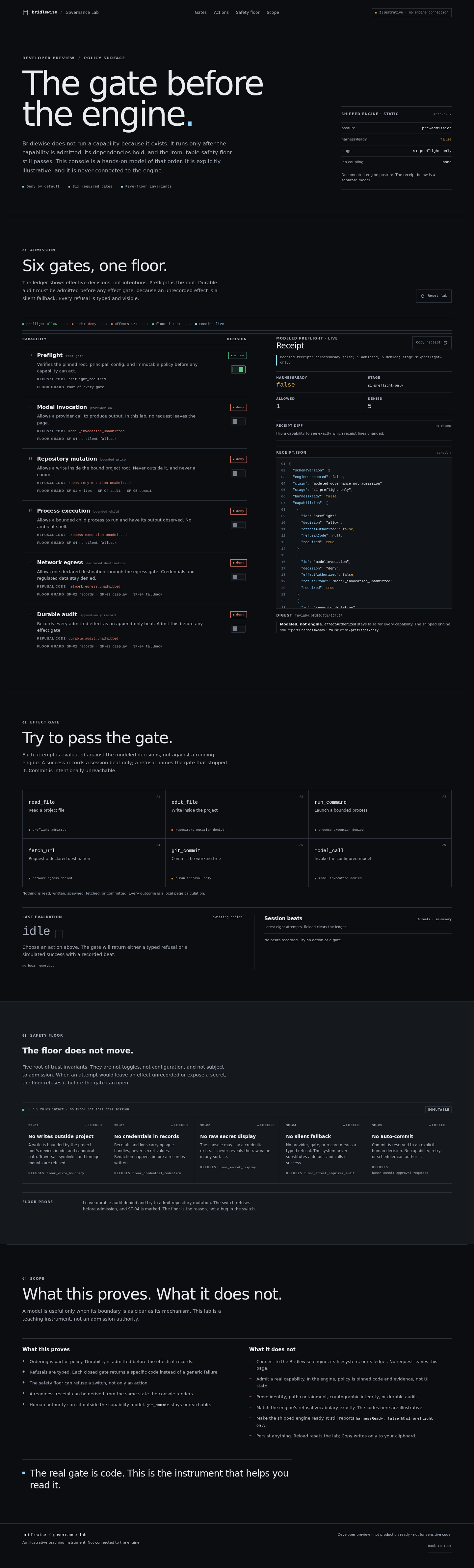
Both pages are interactive, self-contained illustrations. Neither calls a model, executes a tool, or changes a real policy. That is the point: you can inspect the shape before you install anything.
Instrument 01 · The flight recorder
Move through eight beats — intent, model turn, governed tool, file effect, check, finding, refusal, release. Follow cause to effect, inspect the evidence, and see where a redaction happened.
Instrument 02 · The governance console
Toggle capabilities, try an action, and read the typed refusal. The safety floor cannot be toggled. The real engine's policy is code, not this console; the console makes the posture legible.
Instrument 03 · The repository
Actions are checks. Security is custody. Releases are effects. Issues are findings. The GitHub map names what each surface proves — and what it does not.
What is in the tree
01 · Provenance
Turns, tool beats, effects, checks, and findings in one ordered record. A second viewer reads the record; it does not fork the run.
02 · Governance
An unconfigured adapter names what is missing. A ghost tool is refused before dispatch. A blocked action stays blocked; it does not become a plausible substitute.
03 · Safety
Pre-dispatch schema and loop checks, streaming bias and deviation detectors, an artifact sandbox check, and Landlock confinement for shell commands on Linux.
04 · Locality
The server binds to 127.0.0.1. State is local SQLite. Sensitive fields are encrypted, and database keys live outside every checkout.
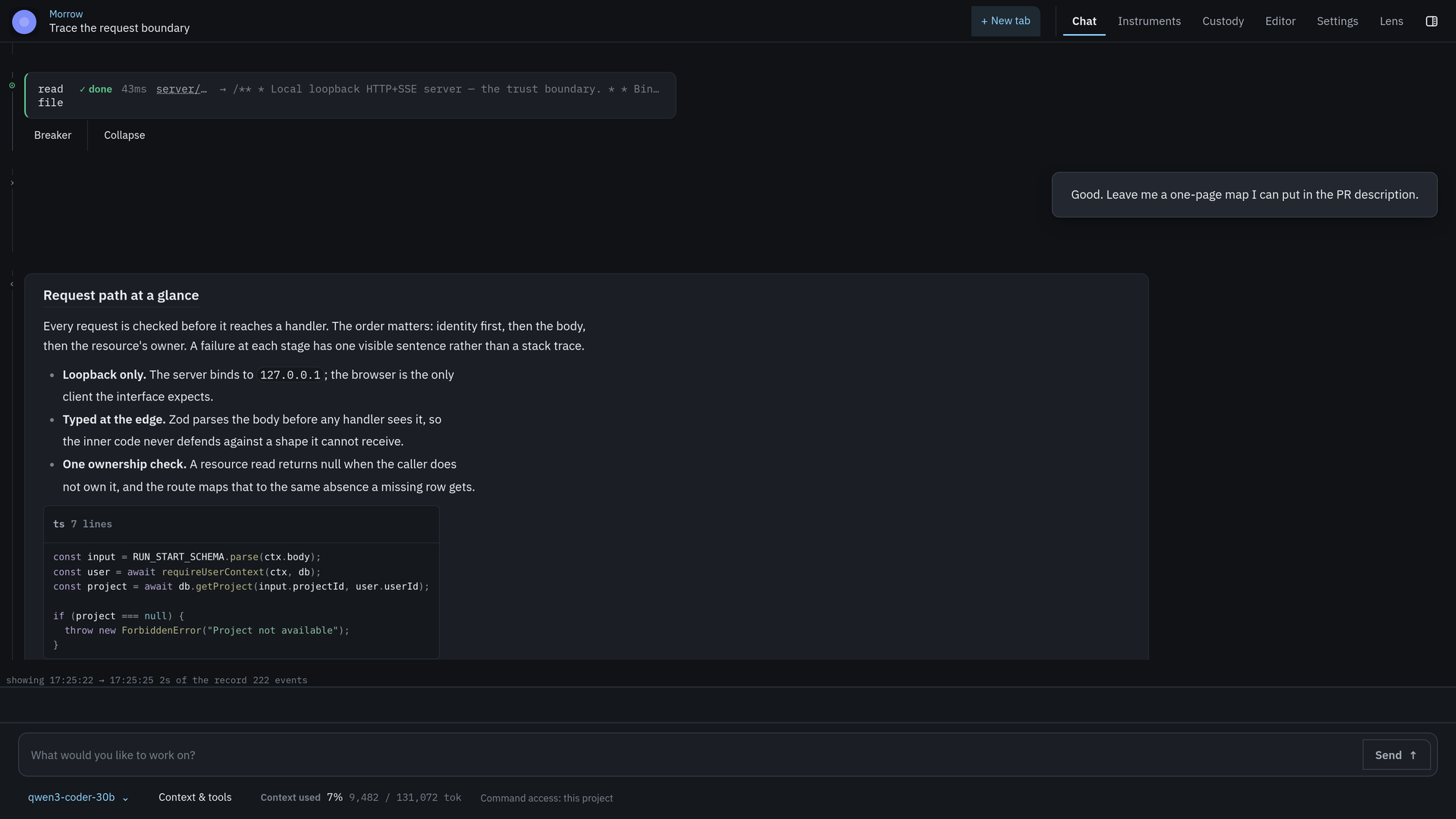
The cockpit
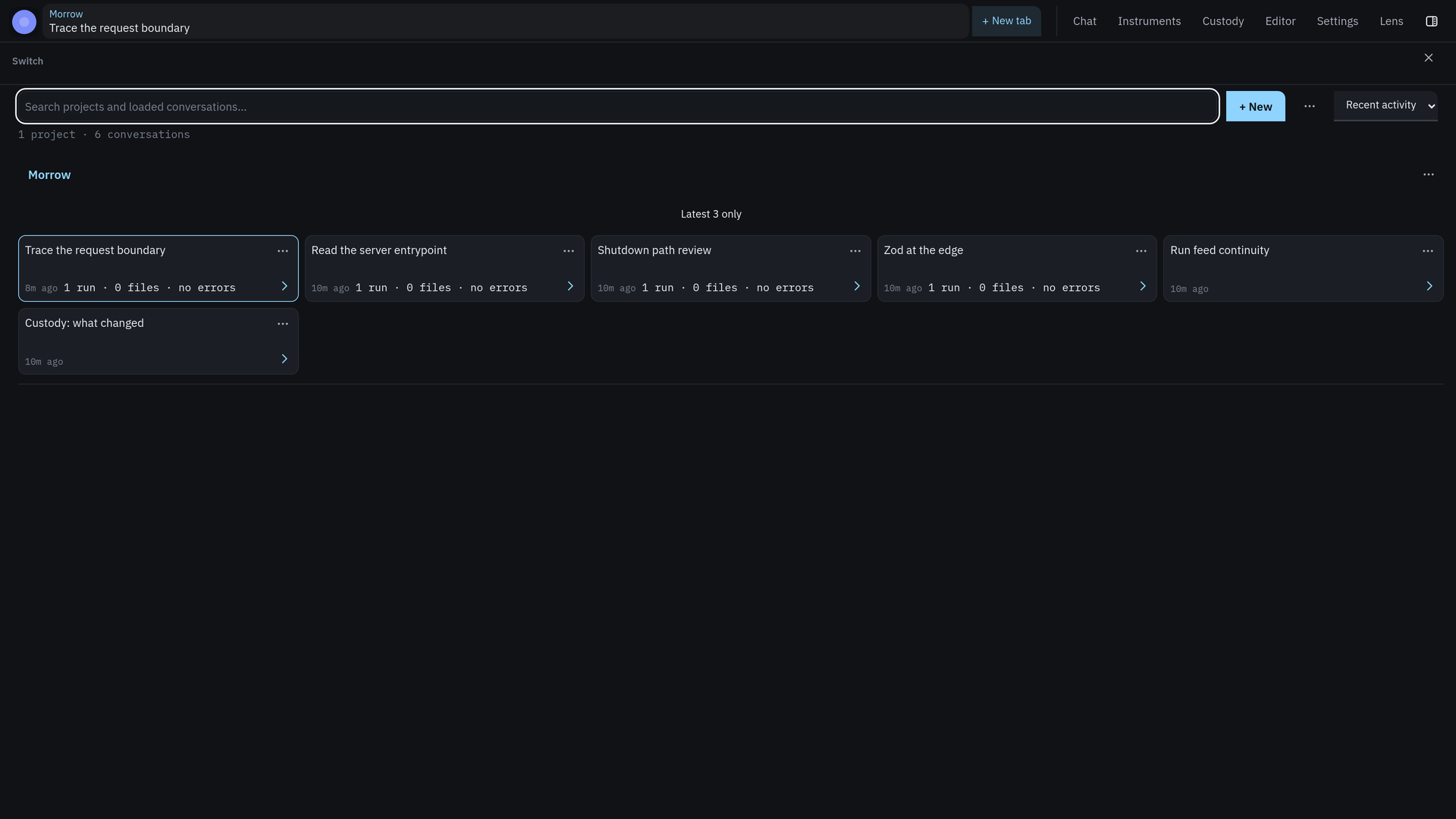
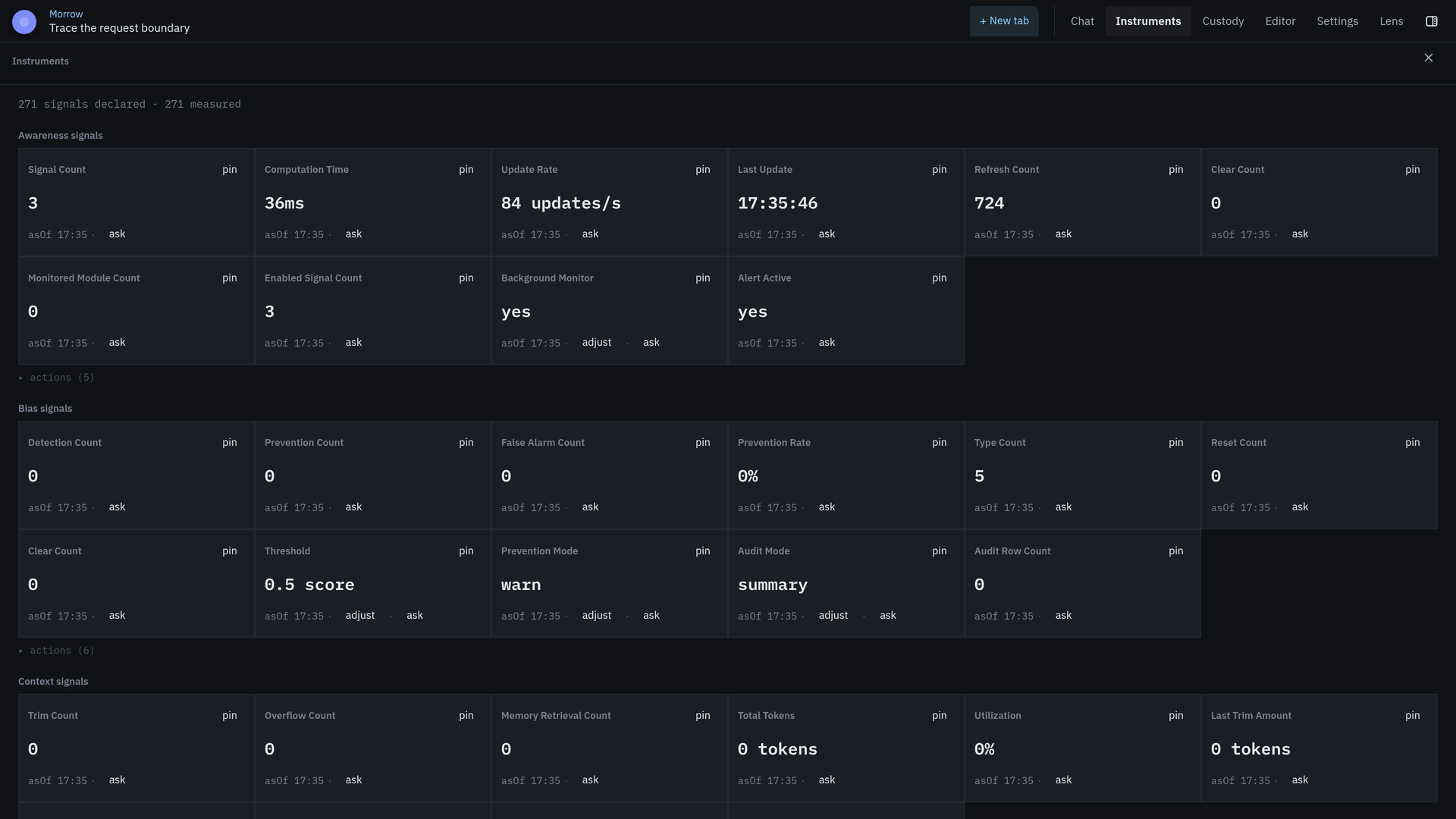
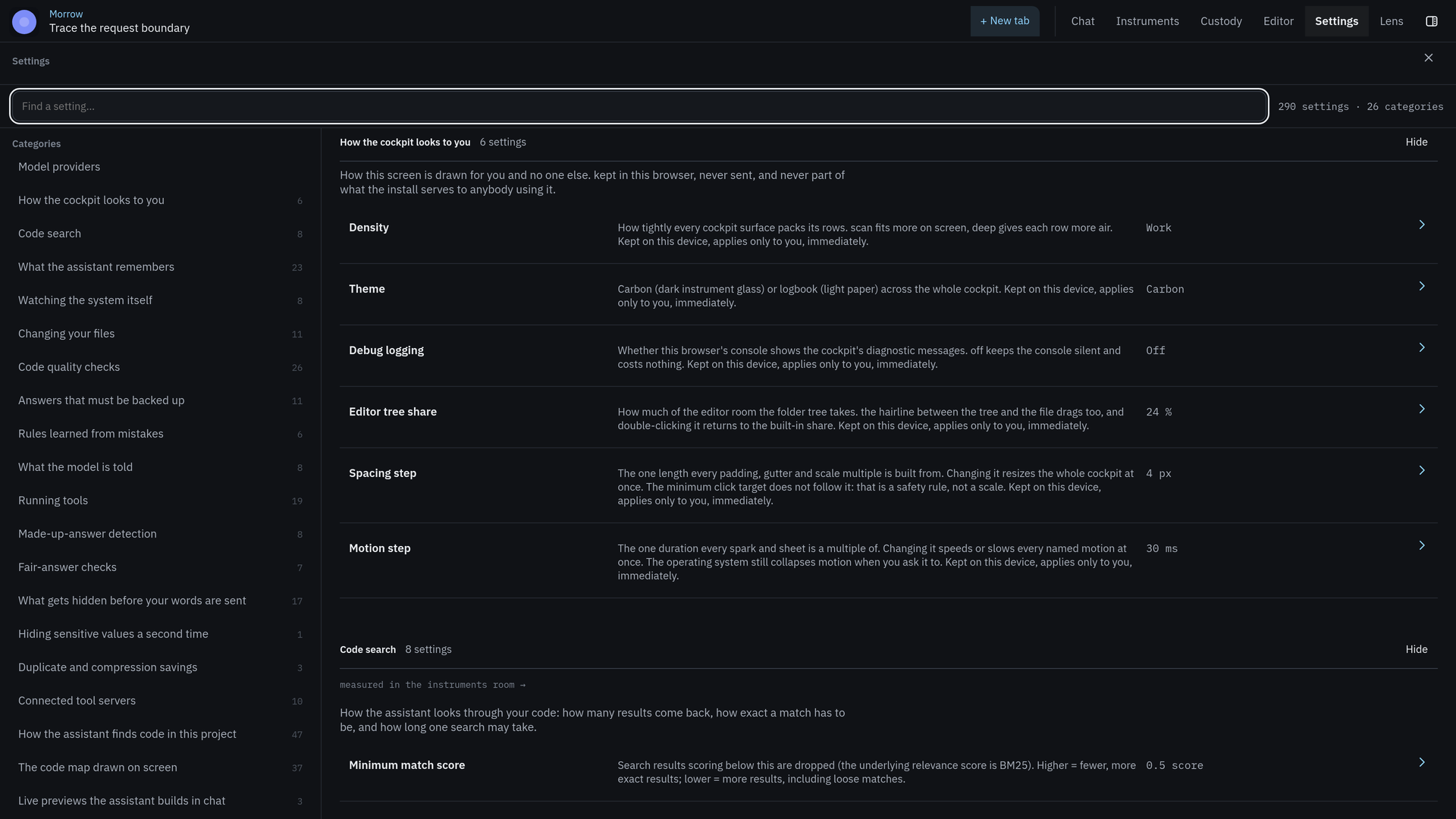
Carbon dark grounds, engraved labels, one live beam for what is actually happening, and a light logbook theme that reads like paper. The design is documented, not decorative.
Before you run it
Do not use Bridlewise on proprietary, regulated, client-confidential, or production code. The engine is pre-admission: harnessReady is false, interactive capabilities remain behind an open governance gate, and there has been no security audit. Expect breaking changes and data loss. Run on a disposable copy, with revocable credentials and your own backups.
Take it for a spin — carefully
Install with Node 24, start the loopback server, create the first account, and point it at a disposable repository. If the evidence does not match the claim, that is a bug worth reporting.