Architecture
Bridlewise is a local web application with four moving parts and one shared contract:
- a Svelte cockpit in the browser;
- a loopback HTTP+SSE server that owns auth, sessions, policy, runs, and storage;
- a standalone engine that owns agents, tools, the editor, intelligence, memory, quality, and the timeline ledger;
- a Landlock guardian that confines server-spawned shell commands and stdio MCP servers on Linux;
- shared wire contracts that both sides import, so routes, schemas, and UI are projected from one declaration.
Nothing in this document is a claim of production readiness. The engine is pre-admission. See Security and limits.
The shape
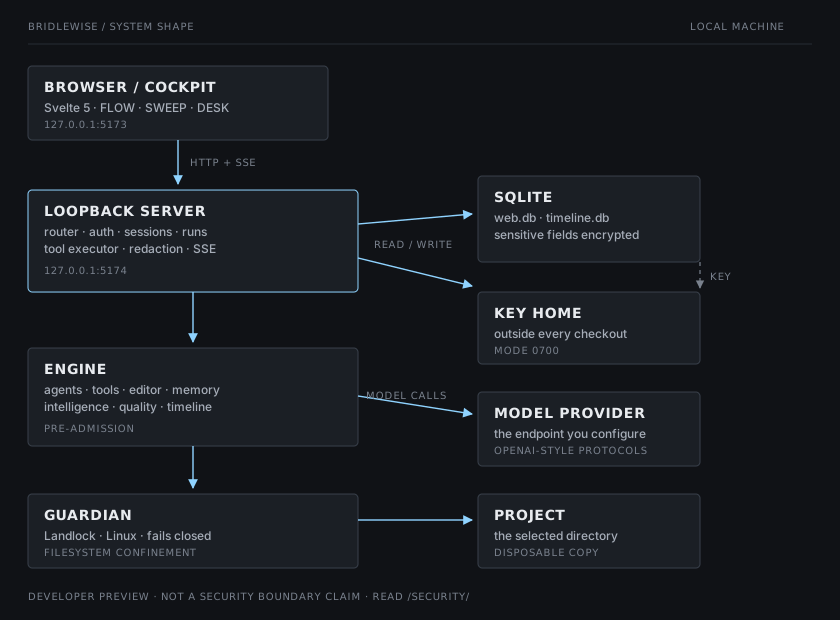
The browser never calls a model provider. It calls the server; the server calls the engine and the provider. The engine does not own auth, sessions, or the HTTP boundary. The guardian does not decide policy; it applies an irrevocable OS restriction to a process tree.
Components
| Component | Path | Responsibility |
|---|---|---|
| Cockpit | src/cockpit/ |
The run surface: FLOW, SWEEP, DESK, HORIZON, and summoned rooms (Switch, Custody, Instruments, Settings, Editor). Renders typed beats and exposes actions; holds only UI state. |
| Client data layer | src/data/, src/state/ |
Broker, ledger, connection, absence handling, and the nanostores that hold reactive state. |
| Server | server/ |
The trust boundary. Auth, sessions, CSRF, rate limits, routing, run lifecycle, tool dispatch, provider wiring, redaction, and SSE. Binds to 127.0.0.1 by default. |
| Engine | engine/ |
Provider-neutral harness core: CLI, agents, tools, transactional editor, code intelligence, quality packs, memory, privacy, safety detectors, timeline, forensics, MCP, and self-protection. |
| Guardian | engine/guardian/ |
A frozen C binary that applies a Linux Landlock ruleset to itself and execvps the payload. The restriction is inherited and irrevocable. |
| Shared contracts | shared/ |
Routes, types, input schemas, UI schema, error codes, and block/module declarations. Declared once; consumed on both sides. |
| Lifecycle scripts | scripts/ |
sd.mjs start/stop/restart/status, dev orchestration, database-key operations, probes. |
| Static shell | public/ |
PWA manifest, service worker, icons. |
Each domain folder has its own README. The product root’s README is the map; this page is the shape.
The life of a run
A run is the unit of work. It is not a request handler, and it is not a chat message. It is an execution with an owner, a stream, a claim, and a record.
- The cockpit asks to start.
POST /api/run/startcarries the prompt and, when bound to a conversation, the chat id. It passes through the router’s auth, CSRF, and rate-limit gates before a handler sees it. - The provider is resolved first. The server loads the account’s provider store and resolves the requested model (or the stored default). No provider, no model, or no key produces a typed refusal —
provider_not_configured,model_not_chosen,model_not_configured, orprovider_key_missing— before any run id, history load, or persisted message. Nothing is half-created. - The run is claimed exactly once. The executor’s first effect is a primary-key claim on
run_executions.run_id. A second execution of the same run is refused by the database before a prompt is assembled. This is why opening a second viewer cannot double-bill a provider or dispatch a tool twice. - Context is assembled. Conversation history, project context, and memory retrieval are combined. The request is deduplicated and, when enabled, compressed at the LLM choke point.
- Redaction runs at the egress owner. Content bound for the provider passes through the single redaction adapter (
server/llm/redaction.ts), which wraps the canonical privacy engine. Callers cannot opt out by using a different route. - The model streams. The server sends the request to the configured OpenAI-compatible endpoint and records the stream as typed model events. Fixture mode is explicit (
HARNESS_WEB_LLM_FIXTURES=1) and marked in the record; a provider failure never silently becomes fixture output. - Tool calls are checked before dispatch. A pre-dispatch gate rejects ghost tools, schema mismatches, and loops. A rejected call is a typed blocker, not a substitute action.
- The tool executes through one executor. The registry resolves the tool, the executor enforces path and project scope, and the result is recorded. File effects are written through the transactional editor; shell commands run under the project’s confinement.
- Checks and findings are recorded. Auto-checks, quality signals, and computed findings become beats with their source and derivation. Runtime detectors can add anomaly or steering events while the turn is still streaming.
- Frames are published. The run publishes frames to a feed.
GET /api/run/:runId/streamsubscribes to that feed and replays fromLast-Event-IDon reconnect. The stream route imports neither the executor nor the LLM bridge; a GET cannot start a run. - The projection is persisted. Chats, messages, run status, and the ledger are written to SQLite. The timeline append is separate from the chat projection; a rewind retracts or replaces a prior turn by appending, so the ledger stays append-only.
- Only an explicit action stops work.
POST /api/run/:runId/cancelcancels; a subscriber disconnecting only unsubscribes. This distinction is deliberate: a closed tab must not destroy another viewer’s paid work.
The trust boundary
The boundary is the loopback server, not the browser tab.
- Bind address. The server binds to
127.0.0.1by default and rejects a request whoseHostis not loopback with a403. The default UI origin ishttp://127.0.0.1:5173; the allowed origin is explicit. Do not overrideHARNESS_WEB_HOSTto expose the server; it is a local boundary, not a deployment mode. - Authentication. Passwords are hashed with scrypt and a per-password salt. Sessions are random 32-byte tokens in HttpOnly, SameSite=Lax cookies; the database stores a SHA-256 hash of the token, so a database leak does not hand over live sessions. Login runs the password check even for an unknown user to avoid a timing oracle.
- CSRF and rate limits. Enforced at the router choke point, not repeated per route. Mutating requests require the CSRF header; public paths are a short, explicit allowlist.
- Authorization. Every route resolves the user context; project, chat, and provider reads are scoped to the owner. Admin-only configuration writes are checked at the route and again at the document writer.
- Path safety. Tools execute in the selected project directory. The filesystem layer rejects traversal and symlink escapes; the editor resolves exact targets inside the project.
- Provider egress. The configured endpoint is the only model destination. There is no Bridlewise relay or hosted proxy in the request path.
- The model is untrusted. Model text and tool arguments are data. Tool calls are validated against schemas before dispatch; artifact HTML is rendered in a sandboxed iframe without same-origin access.
- The project is untrusted. Repository content can contain prompt injection. Redaction reduces accidental secret egress; it does not make hostile repository content safe.
- The local user is inside the boundary. Anyone who can read your user account, the key home, the database, or the process memory can reach the data. Landlock does not defend against the local user; it limits what the confined process can reach.
Storage
| Data | Default location | Notes |
|---|---|---|
| Web database | .bridlewise/web.db |
Override with HARNESS_WEB_DB_PATH. Users, sessions, chats, projects, providers, preferences. |
| Timeline ledger | .bridlewise/timeline.db |
Append-only event ledger with a local SHA-256 chain per record. Queryable by the cockpit. |
| Engine state | .bridlewise/state |
Declared in engine/bridlewise.config.json; receipts and execution evidence. |
| Database key material | Key home | HARNESS_KEY_HOME, else $XDG_CONFIG_HOME/bridlewise/keys, else ~/.config/bridlewise/keys. Mode 0700; never under a checkout or the system temp folder. |
| Dev process records | .dev/ |
PID files and the boot stderr tail, written by sd.mjs. Ignored by git. |
Sensitive database columns are encrypted at the application layer with AES-256-GCM. The ciphertext is bound to its table, column, row, parent, and owner through associated data, so a value moved to another row does not decrypt. IDs, timestamps, status, and roles remain plaintext so they stay queryable. The SQLite file as a whole is not encrypted; protecting the file still depends on filesystem permissions and full-disk encryption.
Keys are not backups. A copy of the database without the key home is unreadable. Back up the key home separately, and do not commit it.
The block and exposure pipeline
A capability is declared once in shared/ as a block or module. The server’s schema layer projects that declaration into:
- route registration and input validation;
- the served UI schema;
- the client’s typed surface;
- the settings, signals, and actions exposed in the cockpit.
A backend capability reaches the screen by generation rather than by hand-wiring a component per feature. The same principle governs tools: one registry, one manifest endpoint, one executor, one renderer. Adding a tool registers it once; the manifest, execution path, and UI pick it up.
This is an architectural preference with a cost: the projection layer is complex, and a bad declaration can surface in several places at once. It is also why the two sides cannot quietly drift into different route or schema spellings.
Code intelligence and the editor
Intelligence is served from engine/src/intelligence/ through server/intelligence/. Tree-sitter parses source; the engine builds repository maps, symbol indexes, dependency graphs (including cycles), data-flow views, reuse candidates, and AST-accurate slices. The model asks for a symbol or a dependency edge instead of receiving a grep dump.
The editor is one unified edit tool. It supports replace, insert, delete, and create through an exact old-string/new-string match, plans and validates the change, and can roll back. The cockpit renders the resulting diff as an effect beat. There is no autonomous commit: git_commit is exposed but returns a governance blocker.
Confinement
The guardian binary applies a Landlock ruleset to itself and execs a payload. The web server uses it per spawned shell command and per stdio MCP server, confining the process and its descendants to the selected project. The CLI itself is not re-exec’d under the guardian: preflight, quality, and harness run as ordinary Node processes even when self-protection is enabled. A missing binary or kernel feature is a typed refusal; it is not silently skipped.
The guardian confines filesystem access. It is not a virtual machine, a container, a network firewall, or a seccomp profile. A confined shell can still reach the network if the process is not otherwise restricted, and the model provider still receives the prompt content you send it. execute_command is separately confined to the selected project.
Non-chat engine commands (preflight, harness, quality) are development and CI tooling that must read src/; even when self-protection is enabled, they run unprotected with a warning. This is a deliberate exception, not a claim that those commands are sandboxed.
Pre-admission
The engine’s governance contract is pinned by engine/src/kernel/root-policy.ts. node src/cli.ts preflight returns an integrity-only receipt with harnessReady: false; each interactive capability (model invocation, tool dispatch, repository mutation, process launch, network use, durable audit) is reported deny with a typed reason until the governance gate admits it. The web harness is a developer preview built around that gate.
That state is the reason for the warning at the top of this site. Architecture can describe the intended boundary; it cannot substitute for admission evidence, independent review, or an audit.
Shipping
Development happens on main of bridlewise. The product tree (the product branch of the same repository) is a projection of main, computed by the promotion tooling, not a hand-edited fork: each product commit names the main commit it was projected from, and recomputing the projection from that commit gives the same tree. Releases are tagged on product; main carries the full test and design record.
For contributors, this has a practical consequence: a change lands on main through a pull request with its tests and evidence, then travels through promotion. The process guide is CONTRIBUTING.md.
What this architecture does not claim
- It does not claim the boundary is complete or audited.
- It does not claim Landlock makes arbitrary code safe.
- It does not claim the timeline is tamper-proof. It is append-only at the application layer with a local hash chain; a local attacker who can rewrite the database can rewrite the chain, and there is no external anchor or signature.
- It does not claim provider compatibility beyond the OpenAI-style protocols implemented here.
- It does not claim the preview is ready for sensitive code.
Those limits are part of the design, not footnotes to hide. Read Security and limits next.